An initiative of the European Commission

AI in Life Sciences​

SCIANCE is gathering evidence on scientific challenges, AI capabilities, infrastructures and emerging practices in “AI in Life Sciences​”​, supporting the identification of strategic priorities for RAISE.
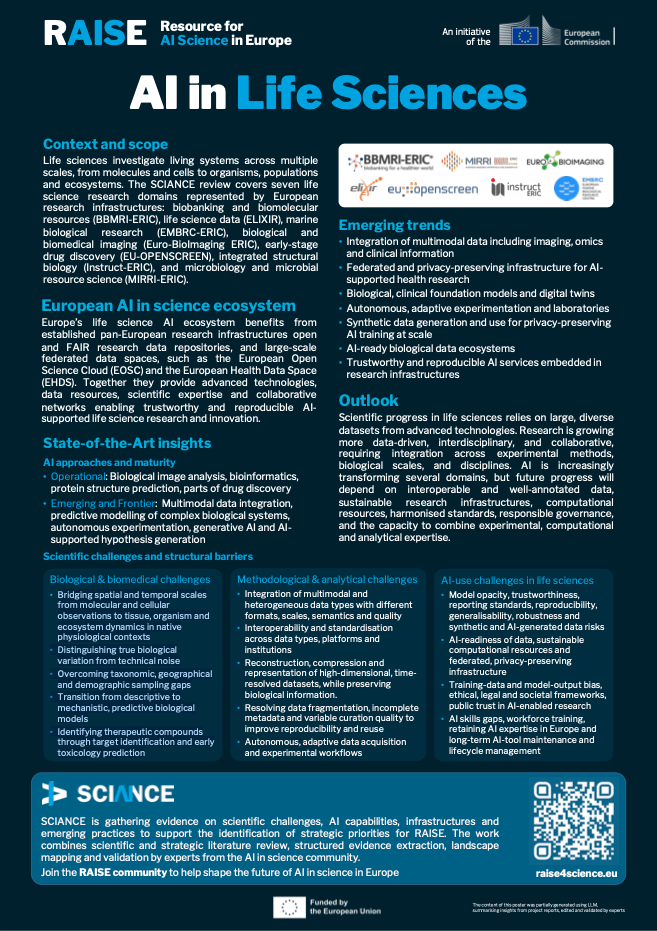
Context and scope​

Life sciences investigate living systems across multiple scales, from molecules and cells to organisms, populations and ecosystems. The SCIANCE review covers seven life science research domains represented by European research infrastructures: biobanking and biomolecular resources (BBMRI-ERIC), life science data (ELIXIR), marine biological research (EMBRC-ERIC), biological and biomedical imaging (Euro-BioImaging ERIC), early-stage drug discovery (EU-OPENSCREEN), integrated structural biology (Instruct-ERIC), and microbiology and microbial resource science (MIRRI-ERIC).

State-of-the-Art Insights​

AI approaches and maturity

  • Operational: Biological image analysis, bioinformatics, protein structure prediction, parts of drug discovery
  • Emerging and Frontier: Multimodal data integration, predictive modelling of complex biological systems, autonomous experimentation, generative AI and AI-supported hypothesis generation

Scientific challenges​ and structural barriers

Biological & biomedical challenges
  • Bridging spatial and temporal scales from molecular and cellular observations to tissue, organism and ecosystem dynamics in native physiological contexts
  • Distinguishing true biological variation from technical noise
    Overcoming taxonomic, geographical and demographic sampling gaps
  • Transition from descriptive to mechanistic, predictive biological models
  • Identifying therapeutic compounds through target identification and early toxicology prediction
Methodological & analytical challenges
  • Integration of multimodal and heterogeneous data types with different formats, scales, semantics and quality
  • Interoperability and standardisation across data types, platforms and institutions
  • Reconstruction, compression and representation of high-dimensional, time-resolved datasets, while preserving biological information.
  • Resolving data fragmentation, incomplete metadata and variable curation quality to improve reproducibility and reuse
  • Autonomous, adaptive data acquisition and experimental workflows
AI-use challenges in life sciences
  • Model opacity, trustworthiness, reporting standards, reproducibility, generalisability, robustness and synthetic and AI-generated data risks
  • AI-readiness of data, sustainable computational resources and federated, privacy-preserving infrastructure
  • Training-data and model-output bias, ethical, legal and societal frameworks, public trust in AI-enabled research
  • AI skills gaps, workforce training, retaining AI expertise in Europe and long-term AI-tool maintenance and lifecycle management

European ecosystem​

Emerging trends​

  • Integration of multimodal data including imaging, omics and clinical information
  • Federated and privacy-preserving infrastructure for AI-supported health research
  • Biological, clinical foundation models and digital twins
  • Autonomous, adaptive experimentation and laboratories
  • Synthetic data generation and use for privacy-preserving AI training at scale
  • AI-ready biological data ecosystems
  • Trustworthy and reproducible AI services embedded in research infrastructures

Outlook

Scientific progress in life sciences relies on large, diverse datasets from advanced technologies. Research is growing more data-driven, interdisciplinary, and collaborative, requiring integration across experimental methods, biological scales, and disciplines. AI is increasingly transforming several domains, but future progress will depend on interoperable and well-annotated data, sustainable research infrastructures, computational resources, harmonised standards, responsible governance, and the capacity to combine experimental, computational and analytical expertise.

Similar Documents

  • Documents

AI in Science Community

RAISE brings together information, infrastructures, initiatives and knowledge to support the development of AI-enabled scientific research across Europe. The aim is to provide an integrated gateway where scientists, AI researchers, infrastructure providers, innovators and policymakers can explore the ecosystem, collaborate and contribute to shape the future of AI in Science.
  • Documents
  • AI Science Community

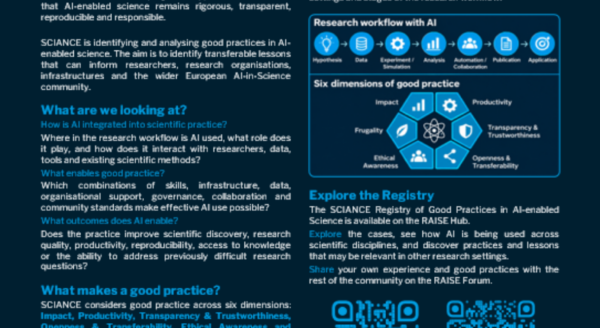
AI in science​ Good Practices​

SCIANCE is identifying and analysing good practices in AI-enabled science. The aim is to identify transferable lessons that can inform researchers, research organisations, infrastructures and the wider European AI-in-Science community.​

  • Documents
  • AI Science Community
  • Interdisciplinary Cooperations
  • AI and Computing Infrastructures

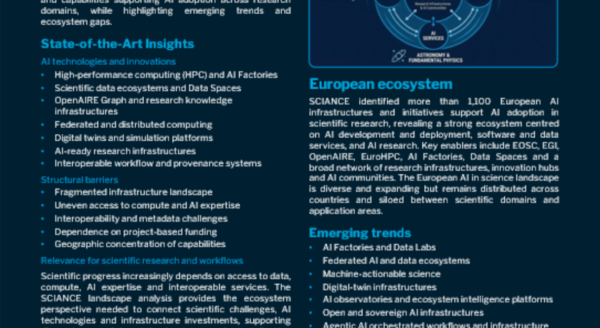
AI in Science​ Infrastructure Landscape​

SCIANCE is gathering evidence on scientific challenges, AI capabilities, infrastructures and emerging practices in “AI in Science​ Infrastructure Landscape​”​, supporting the identification of strategic priorities for RAISE.

  • Documents
  • AI Science Community
  • Frugal AI Models
  • Industry and Innovation

Frugal AI for Science

SCIANCE is gathering evidence on scientific challenges, AI capabilities, infrastructures and emerging practices in “Frugal AI for Science”​, supporting the identification of strategic priorities for RAISE.

  • Documents
  • AI Science Community
  • Open Science and Trustworthy AI

AI for Open Science &​ Trustworthy AI​

SCIANCE is gathering evidence on scientific challenges, AI capabilities, infrastructures and emerging practices in “AI for Open Science &​ Trustworthy AI​​​​”​, supporting the identification of strategic priorities for RAISE.

  • Documents
  • AI Science Community
  • Experimental Design 

AI for Research &​ Experimental Design​

SCIANCE is gathering evidence on scientific challenges, AI capabilities, infrastructures and emerging practices in “AI for Research &​ Experimental Design​​​”​, supporting the identification of strategic priorities for RAISE.

  • Documents
  • AI Science Community
  • Social Science and Humanities 
  • Social Sciences and Humanities

AI in Social Sciences​ & Humanities

SCIANCE is gathering evidence on scientific challenges, AI capabilities, infrastructures and emerging practices in “AI in Social Sciences & Humanities​​”​, supporting the identification of strategic priorities for RAISE.

  • Documents
  • AI Science Community
  • Astronomy
  • Fundamental Physics

AI in Astronomy &​ Fundamental Physics​

SCIANCE is gathering evidence on scientific challenges, AI capabilities, infrastructures and emerging practices in “AI in Astronomy &​ Fundamental Physics​”​, supporting the identification of strategic priorities for RAISE.

  • Documents
  • AI Science Community
  • Earth Sciences
  • Materials Science

AI in Materials Science​

SCIANCE is gathering evidence on scientific challenges, AI capabilities, infrastructures and emerging practices in “AI in Materials Science​”​, supporting the identification of strategic priorities for RAISE.

  • Documents
  • AI Science Community
  • Earth Sciences

AI in Earth Sciences​

SCIANCE is gathering evidence on scientific challenges, AI capabilities, infrastructures and emerging practices in “AI in Earth Sciences​”​, supporting the identification of strategic priorities for RAISE.

  • Documents
  • AI Science Community
  • Life Sciences
  • AI in Life Sciences

AI in Life Sciences​

SCIANCE is gathering evidence on scientific challenges, AI capabilities, infrastructures and emerging practices in “AI in Life Sciences​”​, supporting the identification of strategic priorities for RAISE.

  • Documents
  • AI Science Community
  • Data Science and Advanced Analytics

AI for Data Science &​ Advanced Analytics​

SCIANCE is gathering evidence on scientific challenges, AI capabilities, infrastructures and emerging practices in “AI for Data Science &​ Advanced Analytics”​, supporting the identification of strategic priorities for RAISE.