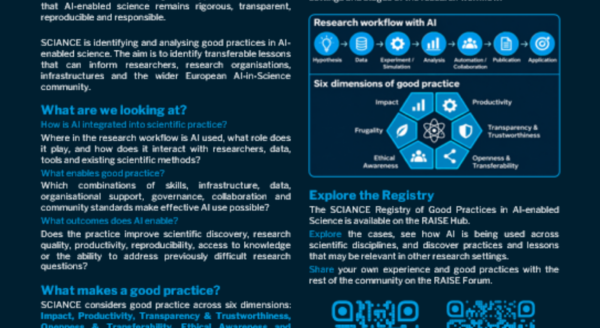
The registry identifies and documents practices in which AI contributes to scientific research, with attention not only to scientific outcomes and technical methods but also to the organisational, infrastructural, ethical, legal and resource conditions that enable their implementation. The work is supported by a review of existing research norms, institutional guidance and community-developed good-practice instruments, and by a common framework of criteria covering six dimensions-Impact, Productivity, Transparency and Trustworthiness, Openness and Transferability, Ethical Awareness, and Frugality-across seven stages of the research workflow. The framework resulted in 107 draft criteria assessed for their essentiality and AI-relevance.
The nomination process identified 96 candidate practices, of which 51 were shortlisted for description across five scientific domains and cross-domain applications. Cases are documented using a common methodology that considers workflow integration, enabling conditions and outcomes, including team composition, interdisciplinary collaboration, data governance, software and computing infrastructures, standards and human oversight. The deliverable also outlines principles for the further development of the registry as a living, cross-domain resource connected to disciplinary guidance, research infrastructures and evolving research practice.
Disclaimer: This project deliverable has been submitted to the European Commission and is pending formal review and approval by HaDEA.