An initiative of the European Commission

AI for Data Science &​ Advanced Analytics​

SCIANCE is gathering evidence on scientific challenges, AI capabilities, infrastructures and emerging practices in “AI for Data Science &​ Advanced Analytics”​, supporting the identification of strategic priorities for RAISE.
Context and scope​

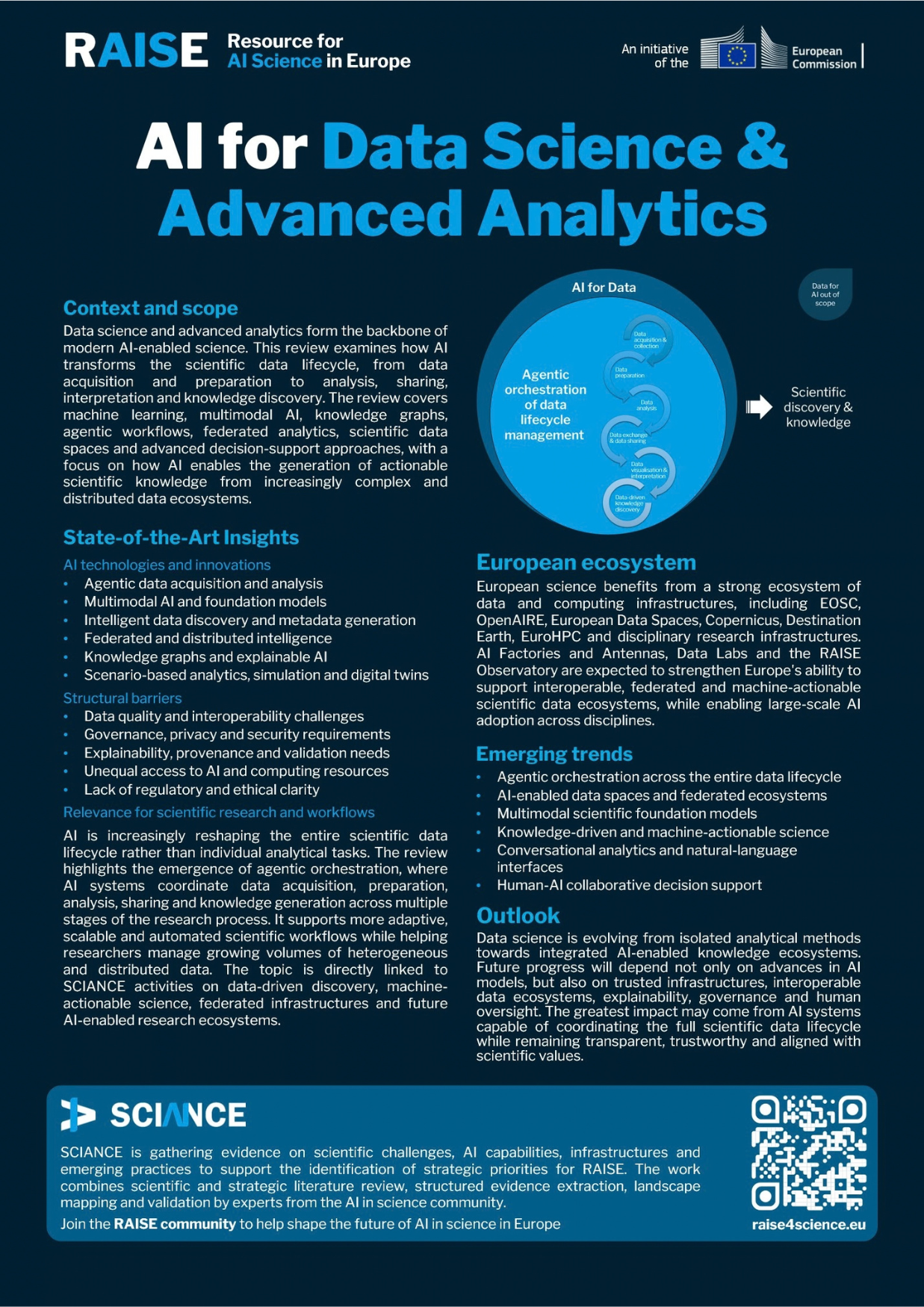
Data science and advanced analytics form the backbone of modern AI-enabled science. This review examines how AI transforms the scientific data lifecycle, from data acquisition and preparation to analysis, sharing, interpretation and knowledge discovery. The review covers machine learning, multimodal AI, knowledge graphs, agentic workflows, federated analytics, scientific data spaces and advanced decision-support approaches, with a focus on how AI enables the generation of actionable scientific knowledge from increasingly complex and distributed data ecosystems.​

State-of-the-Art Insights​

AI technologies and innovations​

  • Agentic data acquisition and analysis​
  • Multimodal AI and foundation models​
  • Intelligent data discovery and metadata generation​
  • Federated and distributed intelligence​
  • Knowledge graphs and explainable AI​
  • Scenario-based analytics, simulation and digital twins​

Structural barriers​

  • Data quality and interoperability challenges​
  • Governance, privacy and security requirements​
  • Explainability, provenance and validation needs​
  • Unequal access to AI and computing resources​
  • Lack of regulatory and ethical clarity​

Relevance for scientific research and workflows​

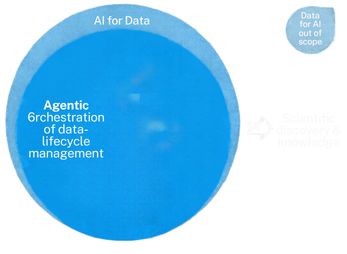
AI is increasingly reshaping the entire scientific data lifecycle rather than individual analytical tasks. The review highlights the emergence of agentic orchestration, where AI systems coordinate data acquisition, preparation, analysis, sharing and knowledge generation across multiple stages of the research process. It supports more adaptive, scalable and automated scientific workflows while helping researchers manage growing volumes of heterogeneous and distributed data. The topic is directly linked to SCIANCE activities on data-driven discovery, machine-actionable science, federated infrastructures and future ​AI-enabled research ecosystems.​

European ecosystem​

European science benefits from a strong ecosystem of data and computing infrastructures, including EOSC, OpenAIRE, European Data Spaces, Copernicus, Destination Earth, EuroHPC and disciplinary research infrastructures. AI Factories and Antennas, Data Labs and the RAISE Observatory are expected to strengthen Europe’s ability to support interoperable, federated and machine-actionable scientific data ecosystems, while enabling large-scale AI adoption across disciplines.​

Emerging trends​

  • Agentic orchestration across the entire data lifecycle​
  • AI-enabled data spaces and federated ecosystems​
  • Multimodal scientific foundation models​
  • Knowledge-driven and machine-actionable science​
  • Conversational analytics and natural-language interfaces​
  • Human-AI collaborative decision support​

Outlook

Data science is evolving from isolated analytical methods towards integrated AI-enabled knowledge ecosystems. Future progress will depend not only on advances in AI models, but also on trusted infrastructures, interoperable data ecosystems, explainability, governance and human oversight. The greatest impact may come from AI systems capable of coordinating the full scientific data lifecycle while remaining transparent, trustworthy and aligned with scientific values.​

Similar Documents

  • Documents
  • AI Science Community
  • Data Science and Advanced Analytics

AI for Data Science &​ Advanced Analytics​

SCIANCE is gathering evidence on scientific challenges, AI capabilities, infrastructures and emerging practices in “AI for Data Science &​ Advanced Analytics”​, supporting the identification of strategic priorities for RAISE.
  • Documents
  • RAISE
  • AI Research

RAISE Secretariat Terms of Reference

The Terms of Reference for the RAISE Secretariat pilot, hosted by the European Science Foundation, outlines the scope, roles, responsibilities and processes governing Secretariat activities in the context of the SCIANCE Coordination and Support Action.

  • Documents
  • SCIANCE
  • Industry and Innovation

Strategic Advisory Board Engagement Plan

The Strategic Advisory Board (SAB) of the SCIANCE project provides high-level guidance to ensure the scientific and strategic quality of project outputs.

  • Documents
  • SCIANCE

Data Management Plan

The Data Management Plan for the SCIANCE project focuses on data collection, usage and sharing activities within the project. It also describes how data is protected, made accessible and available according to existing regulations and the project’s Grant Agreement.

  • Documents
  • SCIANCE
  • AI Research

Mapping Methodology

The SCIANCE Mapping Methodology provides a structured, scalable, and evidence-based approach to analysing the European landscape of Artificial Intelligence (AI) in Science.

  • Documents
  • SCIANCE
  • AI Research

Project Handbook

The Project Handbook supports the consortium partners in the effective and efficient management of the activities performed in the framework of SCIANCE project.

  • Documents
  • SCIANCE
  • Open Science and Trustworthy AI

Communication, Dissemination and Exploitation Strategy

The SCIANCE Communication, Dissemination, and Engagement framework defines an integrated approach to building visibility, fostering stakeholder engagement, and ensuring the uptake, exploitation, and long-term impact of project results within the emerging European AI in Science ecosystem.

  • Documents
  • AI Science Community
  • AI Research

AI in Science Working Group Terms of Reference

The Terms of Reference for the AI in Science Working Groups (AISWGs) define the objectives, structure, roles and responsibilities, and operational modalities of the working groups covering five scientific pilot areas and five cross-cutting AI-related topics.

This is an alt text
  • Documents
  • RAISE

Updated ERA living guidelines on the responsible use of generative AI in research

The Commission has published an update of the ERA Living Guidelines on the responsible use of Generative AI in research – a set of recommendations offering simple and operational guidance to the research community to foster the adoption and responsible use of generative artificial intelligence (AI).