An initiative of the European Commission

Frugal AI for Science

SCIANCE is gathering evidence on scientific challenges, AI capabilities, infrastructures and emerging practices in “Frugal AI for Science”​, supporting the identification of strategic priorities for RAISE.
Context and scope​

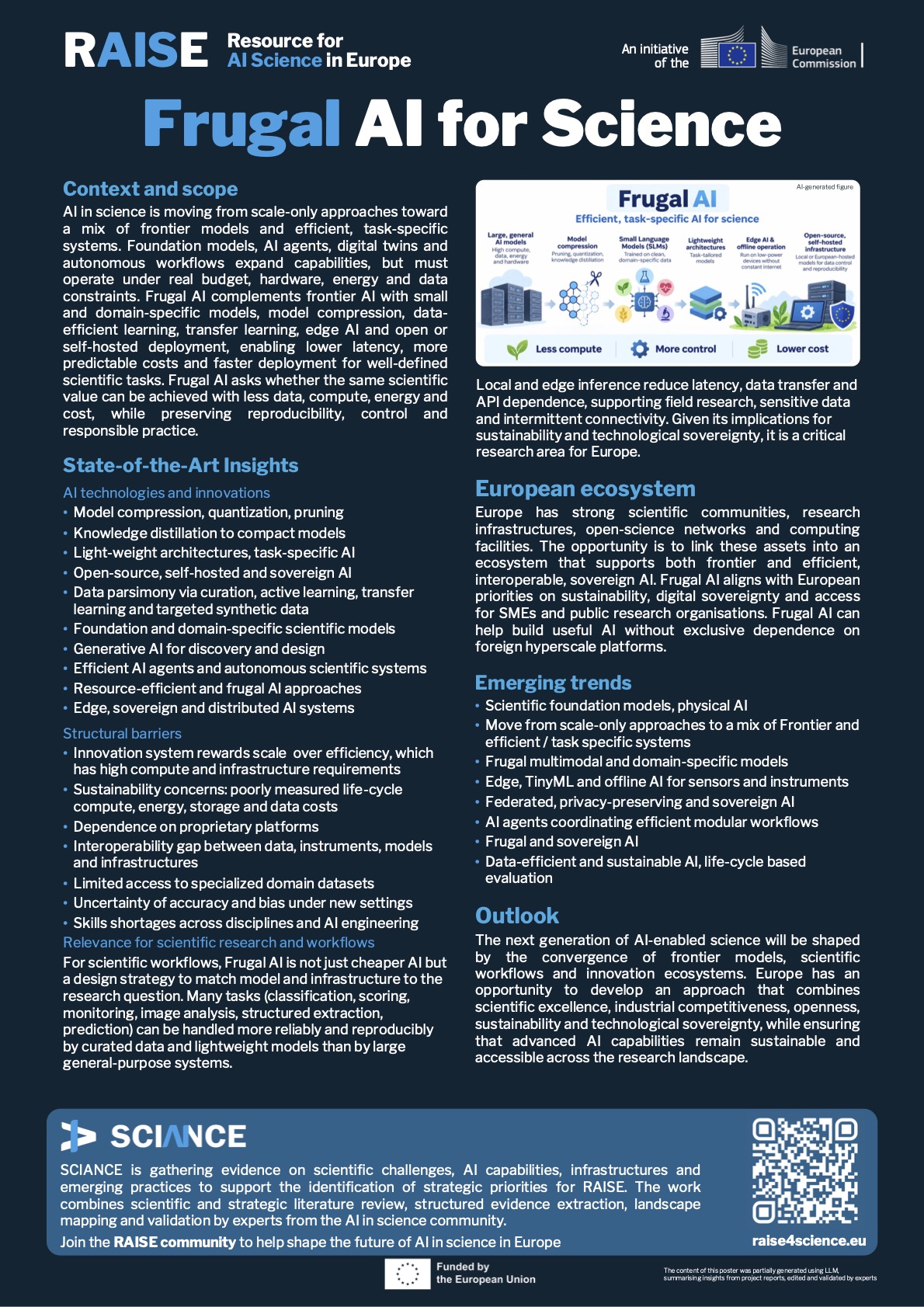
AI in science is moving from scale-only approaches toward a mix of frontier models and efficient, task-specific systems. Foundation models, AI agents, digital twins and autonomous workflows expand capabilities, but must operate under real budget, hardware, energy and data constraints. Frugal AI complements frontier AI with small and domain-specific models, model compression, data-efficient learning, transfer learning, edge AI and open or self-hosted deployment, enabling lower latency, more predictable costs and faster deployment for well-defined scientific tasks. Frugal AI asks whether the same scientific value can be achieved with less data, compute, energy and cost, while preserving reproducibility, control and responsible practice.

State-of-the-Art Insights​

AI Technologies and Innovations

  • Model compression, quantization, pruning
  • Knowledge distillation to compact models
  • Light-weight architectures, task-specific AI
  • Open-source, self-hosted and sovereign AI
  • Data parsimony via curation, active learning, transfer learning and targeted synthetic data
  • Foundation and domain-specific scientific models
  • Generative AI for discovery and design
  • Efficient AI agents and autonomous scientific systems
  • Resource-efficient and frugal AI approaches
  • Edge, sovereign and distributed AI systems

Structural barriers​

  • Innovation system rewards scale over efficiency, which has high compute and infrastructure requirements
  • Sustainability concerns: poorly measured life-cycle compute, energy, storage and data costs
  • Dependence on proprietary platforms
  • Interoperability gap between data, instruments, models and infrastructures
  • Limited access to specialized domain datasets
  • Uncertainty of accuracy and bias under new settings
  • Skills shortages across disciplines and AI engineering

Relevance for scientific research and workflows​

For scientific workflows, Frugal AI is not just cheaper AI but a design strategy to match model and infrastructure to the research question. Many tasks (classification, scoring, monitoring, image analysis, structured extraction, prediction) can be handled more reliably and reproducibly by curated data and lightweight models than by large general-purpose systems.

European ecosystem​

Europe has strong scientific communities, research infrastructures, open-science networks and computing facilities. The opportunity is to link these assets into an ecosystem that supports both frontier and efficient, interoperable, sovereign AI. Frugal AI aligns with European priorities on sustainability, digital sovereignty and access for SMEs and public research organisations. Frugal AI can help build useful AI without exclusive dependence on foreign hyperscale platforms.

Emerging trends​

  • Scientific foundation models, physical AI
  • Move from scale-only approaches to a mix of Frontier and efficient / task specific systems
  • Frugal multimodal and domain-specific models
  • Edge, TinyML and offline AI for sensors and instruments
  • Federated, privacy-preserving and sovereign AI
  • AI agents coordinating efficient modular workflows
  • Frugal and sovereign AI
  • Data-efficient and sustainable AI, life-cycle based evaluation

Outlook

The next generation of AI-enabled science will be shaped by the convergence of frontier models, scientific workflows and innovation ecosystems. Europe has an opportunity to develop an approach that combines scientific excellence, industrial competitiveness, openness, sustainability and technological sovereignty, while ensuring that advanced AI capabilities remain sustainable and accessible across the research landscape.

Similar Documents

  • Documents

AI in Science Community

RAISE brings together information, infrastructures, initiatives and knowledge to support the development of AI-enabled scientific research across Europe. The aim is to provide an integrated gateway where scientists, AI researchers, infrastructure providers, innovators and policymakers can explore the ecosystem, collaborate and contribute to shape the future of AI in Science.
  • Documents
  • AI Science Community

AI in science​ Good Practices​

SCIANCE is identifying and analysing good practices in AI-enabled science. The aim is to identify transferable lessons that can inform researchers, research organisations, infrastructures and the wider European AI-in-Science community.​

  • Documents
  • AI Science Community
  • Interdisciplinary Cooperations
  • AI and Computing Infrastructures

AI in Science​ Infrastructure Landscape​

SCIANCE is gathering evidence on scientific challenges, AI capabilities, infrastructures and emerging practices in “AI in Science​ Infrastructure Landscape​”​, supporting the identification of strategic priorities for RAISE.

  • Documents
  • AI Science Community
  • Frugal AI Models
  • Industry and Innovation

Frugal AI for Science

SCIANCE is gathering evidence on scientific challenges, AI capabilities, infrastructures and emerging practices in “Frugal AI for Science”​, supporting the identification of strategic priorities for RAISE.

  • Documents
  • AI Science Community
  • Open Science and Trustworthy AI

AI for Open Science &​ Trustworthy AI​

SCIANCE is gathering evidence on scientific challenges, AI capabilities, infrastructures and emerging practices in “AI for Open Science &​ Trustworthy AI​​​​”​, supporting the identification of strategic priorities for RAISE.

  • Documents
  • AI Science Community
  • Experimental Design 

AI for Research &​ Experimental Design​

SCIANCE is gathering evidence on scientific challenges, AI capabilities, infrastructures and emerging practices in “AI for Research &​ Experimental Design​​​”​, supporting the identification of strategic priorities for RAISE.

  • Documents
  • AI Science Community
  • Social Science and Humanities 
  • Social Sciences and Humanities

AI in Social Sciences​ & Humanities

SCIANCE is gathering evidence on scientific challenges, AI capabilities, infrastructures and emerging practices in “AI in Social Sciences & Humanities​​”​, supporting the identification of strategic priorities for RAISE.

  • Documents
  • AI Science Community
  • Astronomy
  • Fundamental Physics

AI in Astronomy &​ Fundamental Physics​

SCIANCE is gathering evidence on scientific challenges, AI capabilities, infrastructures and emerging practices in “AI in Astronomy &​ Fundamental Physics​”​, supporting the identification of strategic priorities for RAISE.

  • Documents
  • AI Science Community
  • Earth Sciences
  • Materials Science

AI in Materials Science​

SCIANCE is gathering evidence on scientific challenges, AI capabilities, infrastructures and emerging practices in “AI in Materials Science​”​, supporting the identification of strategic priorities for RAISE.

  • Documents
  • AI Science Community
  • Earth Sciences

AI in Earth Sciences​

SCIANCE is gathering evidence on scientific challenges, AI capabilities, infrastructures and emerging practices in “AI in Earth Sciences​”​, supporting the identification of strategic priorities for RAISE.

  • Documents
  • AI Science Community
  • Life Sciences
  • AI in Life Sciences

AI in Life Sciences​

SCIANCE is gathering evidence on scientific challenges, AI capabilities, infrastructures and emerging practices in “AI in Life Sciences​”​, supporting the identification of strategic priorities for RAISE.

  • Documents
  • AI Science Community
  • Data Science and Advanced Analytics

AI for Data Science &​ Advanced Analytics​

SCIANCE is gathering evidence on scientific challenges, AI capabilities, infrastructures and emerging practices in “AI for Data Science &​ Advanced Analytics”​, supporting the identification of strategic priorities for RAISE.