An initiative of the European Commission

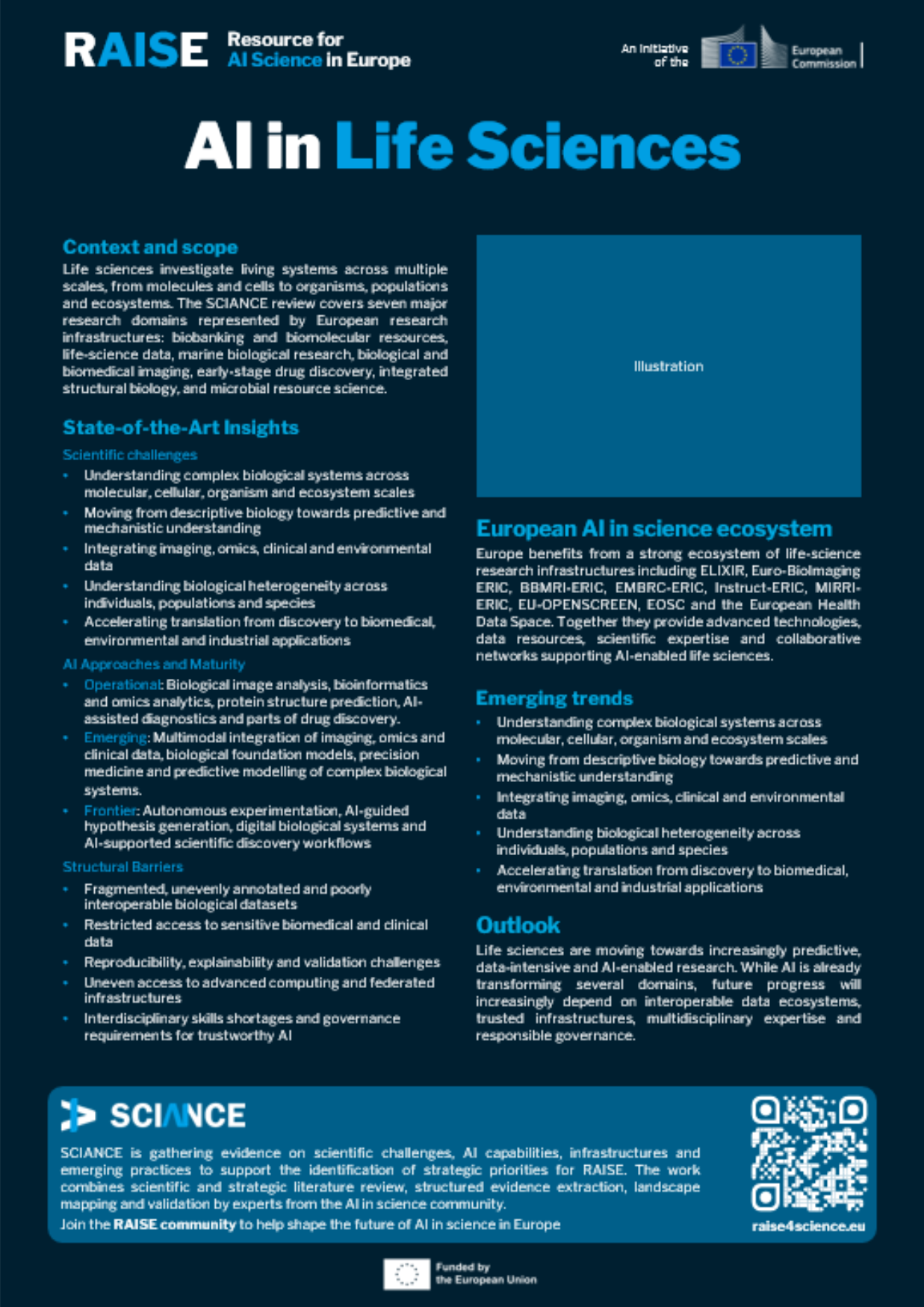
AI in Life Sciences​

SCIANCE is gathering evidence on scientific challenges, AI capabilities, infrastructures and emerging practices in “AI in Life Sciences​”​, supporting the identification of strategic priorities for RAISE.
Context and scope​

Life sciences investigate living systems across multiple scales, from molecules and cells to organisms, populations and ecosystems. The SCIANCE review covers seven major research domains represented by European research infrastructures: biobanking and biomolecular resources, life-science data, marine biological research, biological and biomedical imaging, early-stage drug discovery, integrated structural biology, and microbial resource science.​

State-of-the-Art Insights​

Scientific challenges​

  • Understanding complex biological systems across molecular, cellular, organism and ecosystem scales​
  • Moving from descriptive biology towards predictive and mechanistic understanding​
  • Integrating imaging, omics, clinical and environmental data​
  • Understanding biological heterogeneity across individuals, populations and species​
  • Accelerating translation from discovery to biomedical, environmental and industrial applications​

Structural barriers​

  • Fragmented, unevenly annotated and poorly interoperable biological datasets​
  • Restricted access to sensitive biomedical and clinical data​
  • Reproducibility, explainability and validation challenges​
  • Uneven access to advanced computing and federated infrastructures​
  • Interdisciplinary skills shortages and governance requirements for trustworthy AI​

AI Approaches and Maturity​

  • Operational: Biological image analysis, bioinformatics and omics analytics, protein structure prediction, AI-assisted diagnostics and parts of drug discovery.
  • Emerging: Multimodal integration of imaging, omics and clinical data, biological foundation models, precision medicine and predictive modelling of complex biological systems
  • Frontier: Autonomous experimentation, AI-guided hypothesis generation, digital biological systems and AI-supported scientific discovery workflows​

European ecosystem​

Europe benefits from a strong ecosystem of life-science research infrastructures including ELIXIR, Euro-BioImaging ERIC, BBMRI-ERIC, EMBRC-ERIC, Instruct-ERIC, MIRRI-ERIC, EU-OPENSCREEN, EOSC and the European Health Data Space. Together they provide advanced technologies, data resources, scientific expertise and collaborative networks supporting AI-enabled life sciences.​

Emerging trends​

  • Understanding complex biological systems across molecular, cellular, organism and ecosystem scales
  • Moving from descriptive biology towards predictive and mechanistic understanding​
  • Integrating imaging, omics, clinical and environmental data​
  • Understanding biological heterogeneity across individuals, populations and species​
  • Accelerating translation from discovery to biomedical, environmental and industrial applications​

Outlook

Life sciences are moving towards increasingly predictive, data-intensive and AI-enabled research. While AI is already transforming several domains, future progress will increasingly depend on interoperable data ecosystems, trusted infrastructures, multidisciplinary expertise and responsible governance.​

Similar Documents

  • Documents
  • AI Science Community
  • Experimental Design 

AI for Research &​ Experimental Design​

SCIANCE is gathering evidence on scientific challenges, AI capabilities, infrastructures and emerging practices in “AI for Research &​ Experimental Design​​​”​, supporting the identification of strategic priorities for RAISE.
  • Documents
  • AI Science Community
  • Social Science and Humanities 
  • Social Sciences and Humanities

AI in Social Sciences​

SCIANCE is gathering evidence on scientific challenges, AI capabilities, infrastructures and emerging practices in “AI in Social Sciences​​”​, supporting the identification of strategic priorities for RAISE.
  • Documents
  • AI Science Community
  • Astronomy
  • Fundamental Physics

AI in Astronomy &​ Fundamental Physics​

SCIANCE is gathering evidence on scientific challenges, AI capabilities, infrastructures and emerging practices in “AI in Astronomy &​ Fundamental Physics​”​, supporting the identification of strategic priorities for RAISE.
  • Documents
  • AI Science Community
  • Earth Sciences
  • Materials Science

AI in Materials Science​

SCIANCE is gathering evidence on scientific challenges, AI capabilities, infrastructures and emerging practices in “AI in Materials Science​”​, supporting the identification of strategic priorities for RAISE.
  • Documents
  • AI Science Community
  • Earth Sciences

AI in Earth Sciences​

SCIANCE is gathering evidence on scientific challenges, AI capabilities, infrastructures and emerging practices in “AI in Earth Sciences​”​, supporting the identification of strategic priorities for RAISE.
  • Documents
  • AI Science Community
  • Life Sciences
  • AI in Life Sciences

AI in Life Sciences​

SCIANCE is gathering evidence on scientific challenges, AI capabilities, infrastructures and emerging practices in “AI in Life Sciences​”​, supporting the identification of strategic priorities for RAISE.
  • Documents
  • AI Science Community
  • Data Science and Advanced Analytics

AI for Data Science &​ Advanced Analytics​

SCIANCE is gathering evidence on scientific challenges, AI capabilities, infrastructures and emerging practices in “AI for Data Science &​ Advanced Analytics”​, supporting the identification of strategic priorities for RAISE.
  • Documents
  • RAISE
  • AI Research

RAISE Secretariat Terms of Reference

The Terms of Reference for the RAISE Secretariat pilot, hosted by the European Science Foundation, outlines the scope, roles, responsibilities and processes governing Secretariat activities in the context of the SCIANCE Coordination and Support Action.

  • Documents
  • SCIANCE
  • Industry and Innovation

Strategic Advisory Board Engagement Plan

The Strategic Advisory Board (SAB) of the SCIANCE project provides high-level guidance to ensure the scientific and strategic quality of project outputs.

  • Documents
  • SCIANCE

Data Management Plan

The Data Management Plan for the SCIANCE project focuses on data collection, usage and sharing activities within the project. It also describes how data is protected, made accessible and available according to existing regulations and the project’s Grant Agreement.

  • Documents
  • SCIANCE
  • AI Research

Mapping Methodology

The SCIANCE Mapping Methodology provides a structured, scalable, and evidence-based approach to analysing the European landscape of Artificial Intelligence (AI) in Science.

  • Documents
  • SCIANCE
  • AI Research

Project Handbook

The Project Handbook supports the consortium partners in the effective and efficient management of the activities performed in the framework of SCIANCE project.